
Article: Hammering and setting explained for DIY jewelry enthusiasts
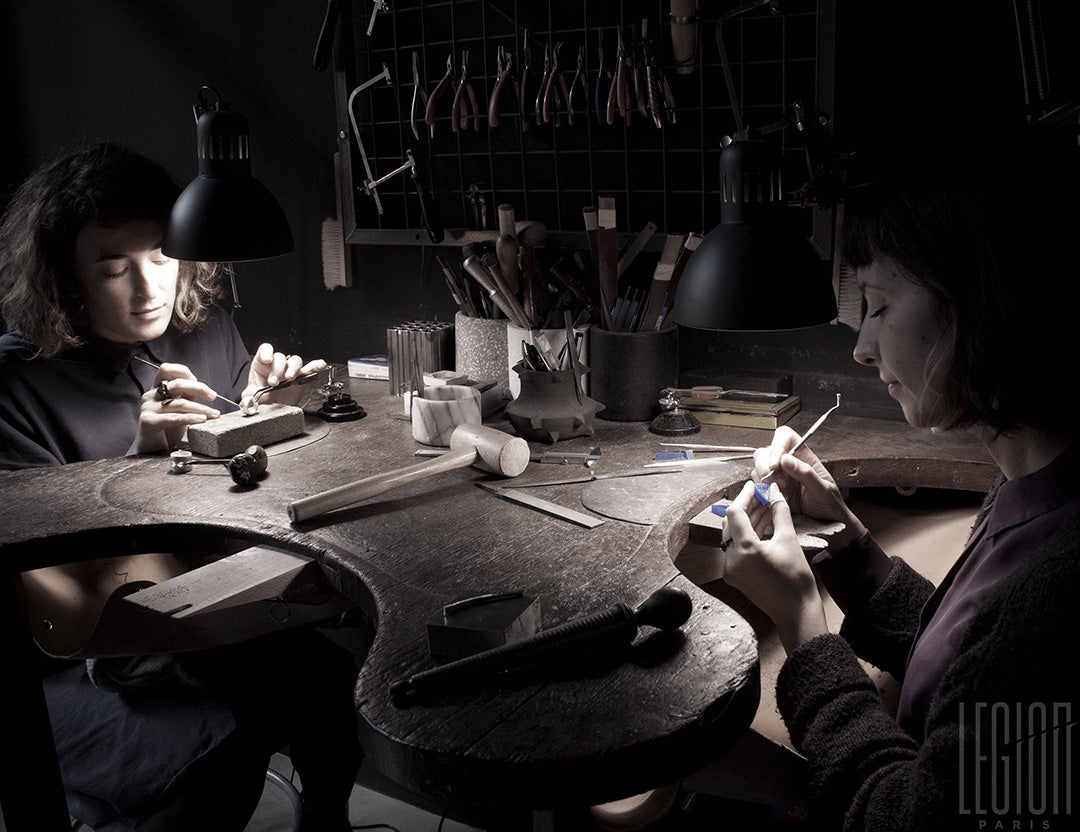
Hammering and setting explained for DIY jewelry enthusiasts
Making your own jewelry is an exciting way to discover the actions and techniques of jewelry making. Among the many methods used by artisans, hammering and setting hold a special place: one allows for transforming and texturing the metal, while the other serves to securely fix a stone.
These two techniques require precision, patience, and true craftsmanship. So, how do they work? What tools are necessary? And can they be easily practiced at home?

What is hammering in jewelry making?
Hammering consists of delicately striking a piece of metal with a hammer in order to modify its shape, texture, or properties.
Contrary to what its name might suggest, hammering in jewelry making is not a succession of random blows. Each impact is controlled: the force, angle, and location of the blow directly influence the final result.
This technique can be used in particular to:
-
add texture to the metal;
-
create an irregular or organic look;
-
slightly modify the shape of a piece;
-
bring light effects to the surface;
-
strengthen certain parts of the metal through work hardening.
Hammering is particularly interesting for fans of homemade jewelry, because it allows you to quickly obtain a very personal finish. Two hand-hammered pieces will never be perfectly identical.
What tools are needed to hammer a piece of jewelry?
To get started, you need relatively little equipment: a hammer adapted for jewelry making, a stable support, and an appropriate work surface.
There are several types of hammers, each producing a different impression. A smooth-faced hammer, for example, will produce a more even surface, while a textured tool will create more pronounced patterns.
The choice of hammer is therefore essential: the tool is an integral part of the final design of the piece.
For amateurs and professionals alike, finding suitable materials, tools, and resources is an important step toward improvement. Specialized platforms such as Ma Passion can allow you to discover various resources devoted to creative hobbies and manual activities.
Why does hammering give jewelry a unique look?
One of the great advantages of hammering is its artisanal character.
When the metal is struck by hand, each impact slightly alters the surface. Light then reflects differently on the raised areas and the depressions.
This is precisely what gives hammered jewelry its lively and sometimes raw appearance.
At LEGION Paris, metalwork is an integral part of our approach to artisanal jewelry. Each piece is handmade in Paris, without mass production or molds, in order to preserve the uniqueness of the craft and the material.
What is jewelry setting?
Setting is the technique of securing a precious, semi-precious, or ornamental stone onto a piece of jewelry.
The role of the setter is twofold: to hold the stone securely while showcasing its beauty.
There are many setting techniques, including:
-
prong setting;
-
bezel setting;
-
bead setting;
-
pavé setting;
-
tension setting.
Each method has its own constraints and produces a different aesthetic.
Prong setting
Very common for rings adorned with a central stone, the prong setting consists of holding the stone with small metal parts raised around it.
Its main advantage is that it lets a lot of light into the stone while minimizing the amount of visible metal.
Bezel setting
In a bezel setting, a thin rim of metal surrounds the stone and holds it in place.
This technique offers good protection, especially for stones with fragile edges. It also gives jewelry a more sober and contemporary aesthetic.
Pavé setting
The pavé setting allows for placing several small stones side-by-side to create a surface almost entirely covered in gems.
The stones are held by small portions of metal, carefully worked by the setter.
This technique requires great precision: a few tenths of a millimeter can make all the difference.

Hammering and setting: two very different actions
Hammering and setting take place at different stages of jewelry making.
Hammering acts primarily on the metal: it allows it to be shaped, textured, and sometimes alters its properties.
Setting, on the other hand, involves the combination of metal and stone. It requires a particularly fine mastery of the dimensions and the tension exerted on the gem.
In both cases, however, one rule remains essential: you must control your action.
A blow that is too strong can deform a piece or leave an unwanted mark. Poorly controlled pressure during setting can damage a stone.
The artisanal craft at the heart of the piece
Behind a finished piece of jewelry often lie dozens of different operations: cutting, sawing, filing, soldering, hammering, polishing, adjusting, setting...
These actions may seem invisible when looking at a finished ring or pendant. Yet, they contribute directly to its character and quality.
This is also what distinguishes artisanal jewelry from mass-produced objects: the material retains the traces of handwork.
At LEGION Paris, we have championed this approach from our beginnings. Our jewelry is imagined and made in Paris, at the workbench, with particular attention paid to materials, textures, and details.
Hammering and setting are therefore not just techniques: they are actions that give a piece of jewelry its identity.
What distinguishes handmade jewelry
Hammering and setting are two fundamental techniques of artisanal jewelry. The first allows the material to be revealed and unique textures to be created; the second allows a stone to be showcased while ensuring its security.
For fans of homemade jewelry, hammering is a great way to start exploring metalwork. Setting opens the door to more technical craftsmanship that is worth learning from professionals.
Because behind every artisanal piece of jewelry, there is, above all, a material, tools, and especially the precision of a human touch.